

© Leona Hofmann / Universität Bremen
Between Emotionalization and Taboo
How memorial sites commemorating the victims of National Socialism position themselves on TikTok – and why these hardly ever feature people persecuted for political reasons
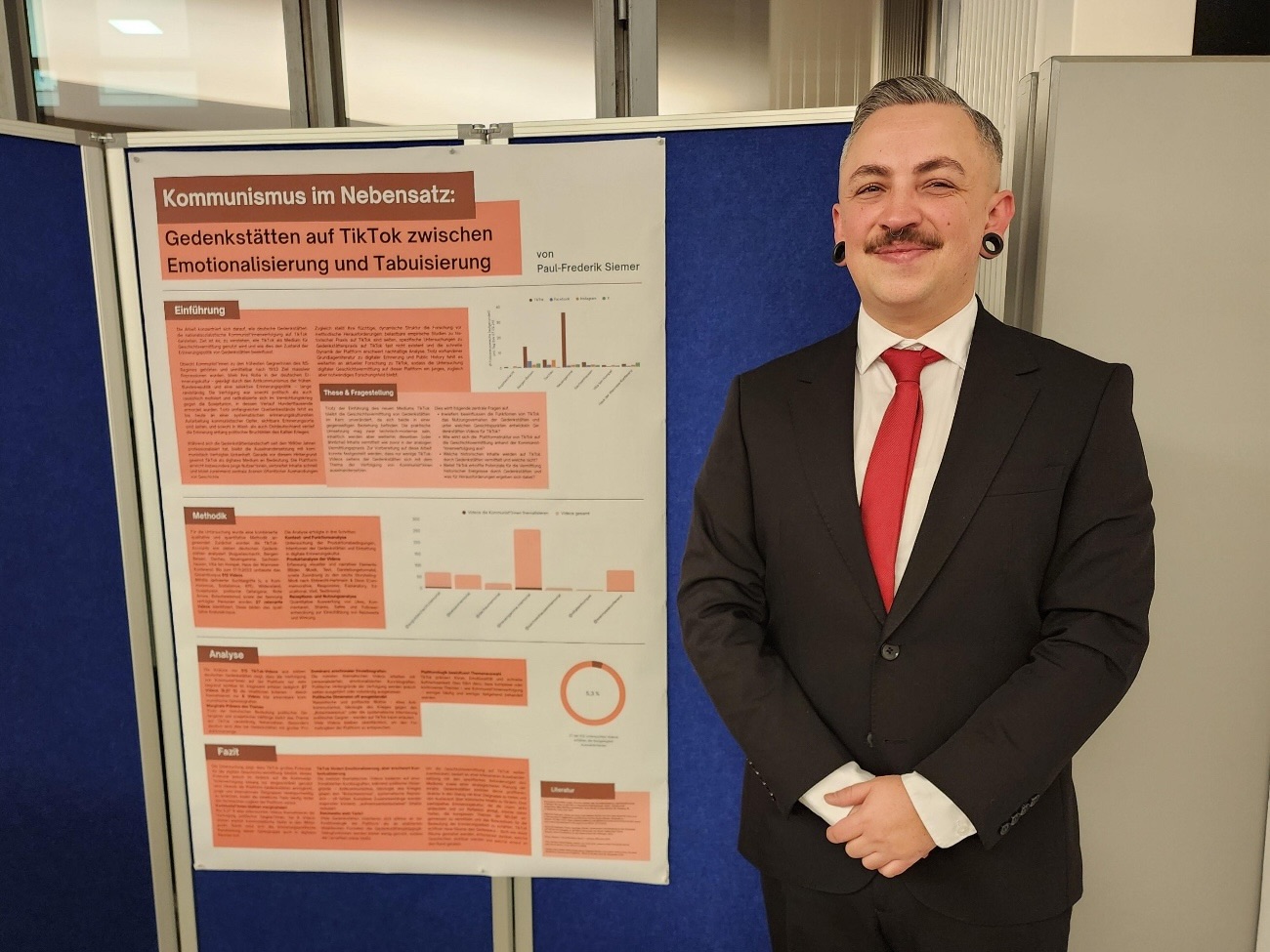
TikTok is usually associated with beauty trends, dance challenges, or comedy clips – not necessarily with commemorating the victims of National Socialism. And yet, more and more memorial sites dedicated to Nazi crimes and persecution are now present on the platform. For his master’s thesis, Paul-Frederik Siemer took a close look at their accounts. Last year, he received the Bremen Thesis Award for his work. In an interview with up2date., he explains why people persecuted for political reasons, especially communists, are largely absent on TikTok, and whether the platform is even a suitable place for remembrance.
Mr. Siemer, what do TikTok videos produced by memorial sites actually look like?
This varies from site to site. Often, however, the content is very specific. For example, they depict portraits of individual prisoners or presentations of specific locations within the memorials. Most videos clearly follow TikTok’s internal logic – they need to grab attention within the first few seconds, often through an emotional appeal. What is usually missing is historical context. I noticed this particularly with regard to victims of anti-communist persecution, which is the focus of my master’s thesis.
What role does the remembrance of communist victims play on these channels?
A very small one. In November 2023, I examined the TikTok channels of all memorial sites that were active on the platform at the time: Augustaschacht, Bergen-Belsen, Dachau, Neuengamme, Sachsenhausen, Villa ten Hompel, and the House of the Wannsee Conference. Although all of these sites are connected to the persecution of communists, only 27 out of 512 videos addressed this topic by the time of my analysis. That is just five percent.
© Thekla Keuck / Universität Bremen
How do you explain the marginal presence of communist victims of persecution on the TikTok channels of memorial sites?
I think it largely reflects Germany’s broader culture of remembrance, in which this topic also is not featured very prominently. There are historical reasons for this. In the GDR, the persecution and murder of communists were interpreted in a strongly ideological way. In contrast, the Federal Republic of Germany sought to distance itself from communism. Bourgeois or conservative resistance figures such as the White Rose or Claus Schenk Graf von Stauffenberg fit more neatly into that narrative. Adding to the complexity is the fact that the term “communist” was used very broadly and imprecisely in the Nazi state. Those persecuted were not limited to members of the Communist Party, left-wing activists, or trade unionists. Many people, for example in Poland or Russia, were also collectively labeled and persecuted as Bolsheviks or communists under German occupation.
So, memorial sites cannot really be blamed for giving this topic so little attention?
I wouldn’t go that far. From my perspective, there would be nothing wrong with dedicating a video to a politically persecuted individual and providing some historical background. My impression, however, is that many memorial sites are still trying to find their footing and define their position on TikTok. Each site has to ask itself how it measures success on the platform: Is it primarily about high view counts, or about balanced content that also includes groups that have so far received less attention?
In your opinion, is TikTok even a suitable medium for discussing National Socialism?
Yes, absolutely. People come in contact with history in almost all areas of society, whether offline or online, and that includes TikTok. It is therefore the responsibility of memorial sites to proactively address remembrance of National Socialism, rather than leaving it to others who may spread ideologically biased or simply false information. Many memorial sites have only recently come to realize the importance of adapting to new media platforms, such as TikTok. In my opinion, they should instead be pioneers, developing innovative and thoughtful strategies for promoting a culture of remembrance on new platforms.