
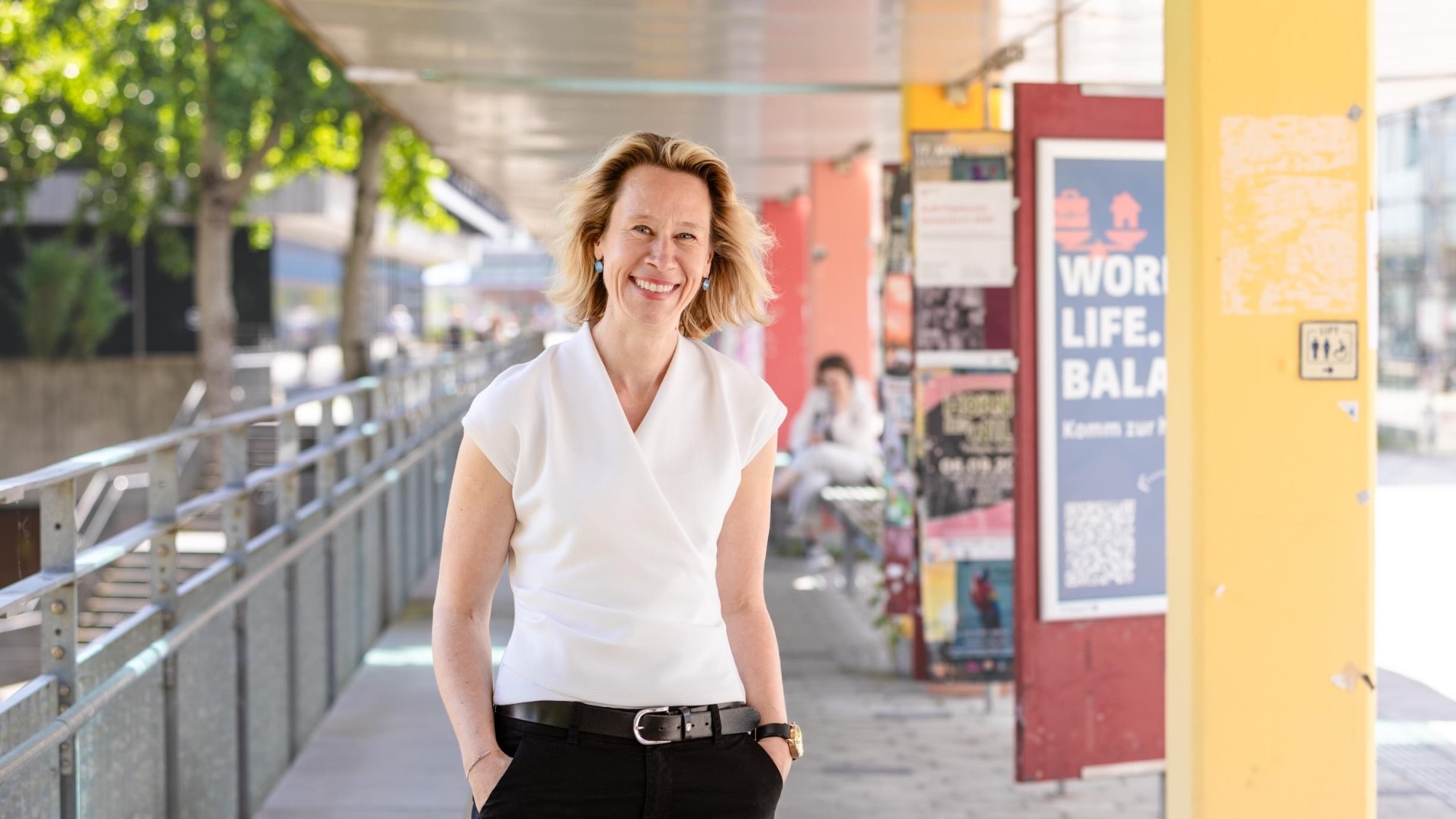
© Matej Meza
“Don’t Let Yourself Be Intimidated”
Literature professor Karen Struve on women, diversity, and ingrained habits at the university
The University of Bremen uses the slogan “Come as you are” in recruiting students. This is a message dear to the heart of literature professor Karen Struve. From personal experience, she is convinced that good research thrives on a broad range of perspectives. She wants to ensure that opportunities and a sense of belonging at the university do not dependent on one’s gender, nationality, or upbringing. up2date. spoke with her on the occasion of the International Day of Women and Girls in Science on February 11.
Am I in the right place? When you’re trying to locate a room in the winding maze of the University of Bremen’s GW2 building, this is a valid question. “It is very easy to get lost here,” says Karen Struve with a laugh. Directions and detours are a common thread in our conversation, since she knows that “Am I in the right place?” is not always just a question of spatial orientation but often hints at something much more existential – whether it refers to the decision to pursue a degree, the chosen degree program, or considerations regarding a doctoral degree.
From the Country to Campus
During the first years of her academic career, Karen Struve often wondered if she was on the right path. “I was the first in my family to go to university,” says the 49-year-old, who grew up in a town near Kiel. “I am a farm girl. My parents are eighth-generation farmers.” There was a strong intrinsic motivation for her decision to pursue a degree, she remembers. “I wanted to study something that would help me understand human nature and emotions. Something that cannot be measured by a profit margin.” That is why she decided to study Romance languages and cultural sciences at the University of Bremen.
“Gray-haired Men in Gray Suits” Karen Struve
In the beginning, she could not have imagined that the university might later be her place of work. However, a professor encouraged her to pursue a doctoral degree. Karen Struve applied for a scholarship in a doctorate program. At symposiums in the early aughts, she soon became aware that her research field was dominated by “older, gray-haired men in gray suits.” This has changed greatly since then. “As a young, tall, blonde woman I was often not taken seriously,” she remembers. Plagued with self-doubt, she wondered whether she, as a working-class child, would ever be able to adopt the mannerisms and behavior of children of academics.
Ultimately, her greatest asset was her persistence. She says, “At some point, I decided that I wouldn’t leave without a fight. As long as I held an academic position, I would work to help shape the field. Then, I could still be myself, while hopefully opening doors for people who don’t conform to certain conventions.”
Looking at Karen Struve’s academic résumé, it is obvious that her approach was successful. Her dissertation on transcultural French contemporary literature received the prestigious Prix Germain de Staël award from the German Association of Franco-Romanists and the French Embassy in Germany; her habilitation received the Elise Richter Award of the German Society of Romance Studies. She has held a full-tenure W3 professorship for Franco-Romance literature at the University of Bremen since 2021. “It is nice to be appreciated here,” she says. “The University Executive Board truly takes our faculty into consideration and doesn’t just focus on the traditionally well-funded technical and natural sciences.”
Telling Stories Is a Basic Need
Interacting with and reaching out to the Bremen community is also important to her. She and her students organize readings, panel discussions, and exhibits at various locations in Bremen. “For me, literature is not meant to be exclusive to high-society. Telling and listening to stories is a basic human need – whether in the form of books, films, plays, or TV series.”
Balancing career and family life has always been important to Karen Struve. “It was always clear to me that if I couldn’t balance both, then university wouldn’t be the right place for me,” she says as a mother of two children, now in their teens. She now is determined to put family-friendly structures in place – for instance, by holding meetings in the morning, avoiding weekend seminars, and encouraging students to bring their children to lectures if childcare is not available. “I have even had lectures where I was holding a student’s baby.”
Challenges in Careers and Family Planning
Family planning presents particular challenges for women. Structural problems often mean a lack of job security for women in the humanities, who often don’t know until they are in their forties whether temporary contracts will turn into a permanent perspective at a given university, for example, as a professor. “I do notice that our university has developed a sensitivity for this topic – and there is a shared understanding for the fact that gender-specific challenges should not lead to worse outcomes within hiring committees.” The fact that four of the five members of the University Executive Board are women is a strong sign that women at the University of Bremen have many opportunities.
Based on her personal experience, Karen Struve encourages students and mentees to pursue their passion in the topic of their choice. “It is important to not let yourself be intimidated and assume everyone else knows better than you do,” she says. She continues to observe that beginning female students often struggle to find their voice in discussions, whereas many of their male peers have no qualms about sharing their thoughts and taking up space. “Because of this, I urge everyone in my seminars to actively contribute their thoughts and questions to our discussions,” she says. She believes that “good research and teaching thrive when a variety of perspectives are considered. This is why it is so important to me that our students feel a real sense of belonging – independent of their gender, their background, or their nationality.” Just come as you are.