
© Leona Hofmann / Universität Bremen
Research Freedom Rediscovered
Why Two Postdocs from Elite U.S. Universities Are Continuing Their Careers in Bremen
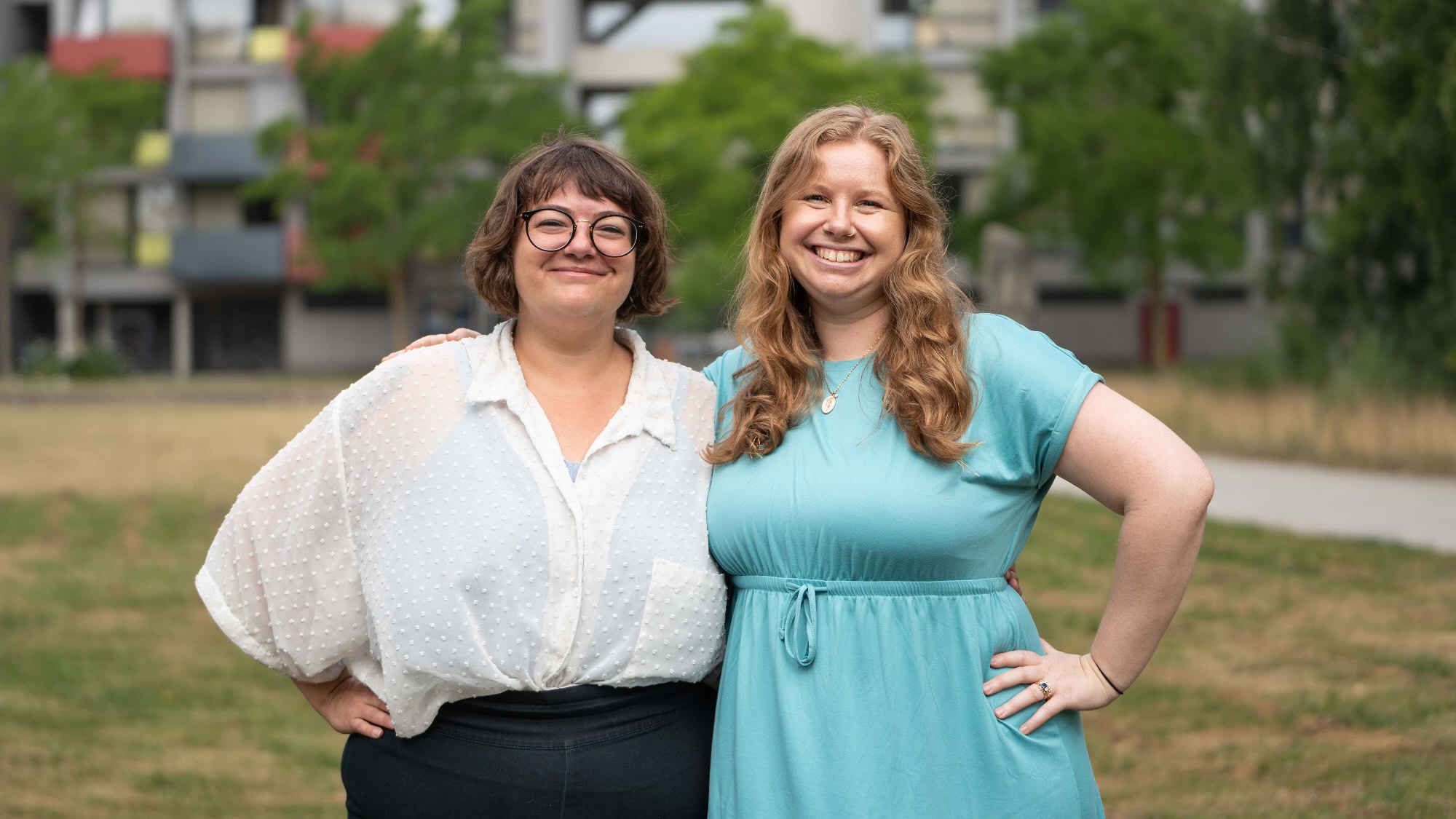
One researcher studies how new political parties disrupt existing systems; the other explores how young people can engage with climate change without becoming overwhelmed by feelings of helplessness. Dr. Alex Mierke-Zatwarnicki and Dr. Emily Olsen both launched promising academic careers in the United States. But under the Trump administration, their prospects there began to diminish. A fellowship program at the University of Bremen now gives them the opportunity to continue their important research.
When Alex Mierke-Zatwarnicki reflects on her final months in the U.S., what she remembers most is a growing sense of uncertainty. As a Canadian citizen with a U.S. residence permit, she watched with increasing concern as visa rules shifted, social media profiles of non-U.S. citizens were scrutinized for undesirable content, and even the residency status of green card holders was called into question. “As a non-U.S. citizen, I increasingly felt that I had to hold back my opinions in order not to jeopardize my residency status,” says the 33-year-old, who earned her Ph.D. at Harvard. “The measures felt like a broad attack on civil society, universities, and research. The fact that existing policies and norms were not respected made the situation even more chaotic and concerning for me.” The political scientist is all the more grateful to have found a new and attractive research environment in the team led by Professor Sophia Hunger at SOCIUM at the University of Bremen. “Bremen has given me a strong academic community, a break from the immediate threats in the U.S., and the chance to feel secure in one place. That has helped my state of mind and productivity enormously,” she says.
“Bremen has given me a strong academic community, a break from the immediate threats in the U.S. Alex Mierke-Zatwarnicki
University of Bremen Foundation Supports U.S.-Based Postdocs
The “Ad hoc Transatlantic Fellowship Program” is funded by the University of Bremen Foundation. It supports postdocs affected by project cancellations and funding cuts from the U.S. administration. What Alex Mierke-Zatwarnicki experienced in the U.S. is also part of her research. She studies political upheavals, group identities, and the creation of a sense of “we.” Her work focuses on what are known as “challenger parties”– political parties that question established structures.
“Anti-system politics is not new,” she says. “If you look at history, almost every challenger party has expressed some form of intense criticism of the system in which it competes.” What differs, however, are the strategies they use to attract and bind supporters. Early socialist parties, for example, built their identity around the struggle for the working class, creating a strong sense of belonging among their followers. Another strategy is creating a sense of “we” based on exclusion – for instance, when parties claim to represent the “ordinary people” while simultaneously defining who belongs and who does not. This can be observed in many newer right-wing parties, such as Germany’s AfD. Donald Trump also employed a similar strategy: despite his wealth and ties to an established party, he presented himself as an alternative to the establishment.
Currently, there is a strong focus in Europe on how mainstream parties can coordinate to stop far-right parties, says Mierke-Zatwarnicki. “Much more emphasis is placed on that than on how we can address the social problems that make people so angry that they want to support these parties. From my perspective, in order to prevent the rise of the AfD, my most important recommendation to German parties would be tackling the cost-of-living crisis.”
“I Feel Like This Was Meant to Happen”
Biologist and education researcher Emily Olsen is also working on a topic that has gained importance in recent years – climate change. However, research in this field has been heavily affected by funding cuts in the United States. At one point, she recalls, she believed she might have to end her academic career. The 33-year-old, who earned her Ph.D. at Pennsylvania State University, also sees the Bremen fellowship as a stroke of luck: “Ever since I was a student, it was my dream to work internationally as a researcher. I really like Bremen and the university, and I just feel like this was meant to happen.” She says she felt welcome from the very beginning and received valuable support from the university’s Welcome Center.
“My goal is to support young people here in Bremen and work with them to find ways of emotionally processing information about climate change so they can remain capable of taking action and not become too overwhelmed,” says Olsen. Another target group is professionals who deal with climate change and environmental issues in their work. They, too, often carry a heavy emotional burden – precisely because they understand the fragility of our natural life-support systems. Simply sharing these feelings with others can often be helpful and relieving.
At the University of Bremen’s Institute of Technology and Education, Olsen is part of Professor Alisha Heinemann’s research group and the interdisciplinary research platform “Worlds of Contradiction,” where she is testing various pedagogical methods. “One example is nature journaling. You go outside with a piece of paper and observe something like a bird or a tree. You draw it or write about it, while quietly observing and noting your own questions. It’s a bit like meditation, but with its own structure.” Forest bathing can also help people relax and regain confidence in their ability to act. “Many studies show that a connection to nature benefits physical and mental health and strengthens resilience – both individually and collectively.”
“The city has many beautiful natural areas that are also easy to reach by public transportation” Emily Olsen
Bremen offers favorable conditions for this. “The city has many beautiful natural areas that are also easy to reach by public transportation,” Olson says. She discovered her passion for such experiences during her biology studies, when she took a course called Outdoor Education. “I loved simply being outside with preschool children and seeing the wonder on their faces when they spotted a bird or found a slug on the path.” Emotional connections to nature are also important for adults. “Until now, traditional Western sciences and science education have primarily focused on the transmission of knowledge,” she says. Emotions have tended to play a secondary role. “The idea has been: if you know the name of a tree, you’ll come to love it. That may be true for some, but not for everyone. Emotions are the foundation of our behavior and our humanity – so why not include them in learning contexts?”
Both Alex Mierke-Zatwarnicki and Emily Olsen can imagine continuing their research in Germany after their fellowship – even if the political winds in the White House were to change again.